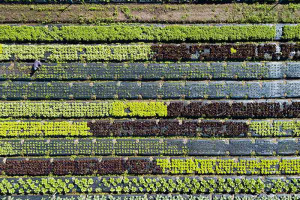
Micro Flood looks like old-fashioned flood irrigation, yet it can behave very differently. By splitting a long bay into short “micro blocks” and feeding them in sequence with a simple mechanical valve, it becomes possible to wet the useful root zone more evenly, waste less water, and even irrigate soils as challenging as blown sand. The idea is practical: use gravity, small pipes, and smarter flow patterns to grow more food from limited water.
Why A New Flood Method Matters
In August 2003, a group of specialists—agriculture officers, irrigation engineers, water experts, and pipe manufacturers—met in the Kouebokkeveld, around 300 kilometres north of Cape Town, to view a new irrigation approach. It looked like conventional flood irrigation at first glance, but it was reportedly doing something close to “impossible”: flood irrigating soil that is essentially blown sand, from relatively small pipes, without losing large volumes of water below the root zone. If that claim sounded too good to be true, it was exactly the right reaction. The point of the trial was to test whether a deceptively simple system could deliver real efficiency, using gravity feed and minimal infrastructure.
World Vision’s interest was straightforward. In places where water is scarce or unreliable, irrigation efficiency is not a technical curiosity. It can be measured in how many additional people can be fed from a finite water resource. Much of the world still irrigates with flood methods, often in regions that cannot rely on electricity for pumps, let alone computers and sensor networks. The challenge was to find something that stays low-cost and gravity fed, but performs like a modern system. Micro Flood was developed as a response to that challenge. :contentReference[oaicite:0]{index=0}
The Basic Physics Behind Flood Water
Flood irrigation looks simple—water moves over the surface—yet the outcome depends on what happens below the surface. A helpful mental model is the “hose experiment”. Put a garden hose on bare soil: a puddle forms under the hose, then spreads outward as surface flow. If you poke a screwdriver into the ground near the hose, the hole fills right to the top because the soil is saturated and hydraulic pressure is high. Move further away: the hole still fills, but not as close to the top. Further again: the soil is damp but no free water appears. This shows two important zones: a near-source zone that tends to become too wet and deep, and a far zone that can stay too shallow and evaporate quickly.
Under the surface, there is subsurface flow caused by hydraulic pressure. In sandy soils, that pressure “wedge” is steep; in clay soils, it can be much flatter. Beyond the main pressure-driven front, other mechanisms still move water—surface tension and wicking are major ones, but also processes like local evaporation/condensation cycles, osmosis, and the plant’s own redistribution of water through its roots. The practical point is that water does not magically spread into a uniform moisture content. It forms a complex, moving three-dimensional wetting pattern that changes with soil type, slope, initial moisture, and flow rate.
Where Flood Irrigation Wastes Water
Two losses dominate. First, shallow water near the surface is vulnerable to evaporation, especially in hot, dry conditions. Second, water that penetrates beyond the effective root zone is wasted for the crop and can trigger secondary problems such as nutrient leaching and salinity risk. Between those extremes is the “useful zone”: wet enough to supply the roots, but not so deep that water is pushed below root reach. A practical irrigation system should aim to place most of its water into that useful zone, along most of the field length.
Furrow irrigation is often more efficient than broad bay flooding because it reduces the wetted surface area (less evaporation), while subsurface flow can still distribute water sideways between furrows. The deeper message, however, is not “furrows good, bays bad”. It is that the shape of the wetted profile—and how evenly it develops from start to finish—is the true measure of efficiency.
Why Soil Type Changes Everything
Soil permeability controls how quickly water soaks downward and how far it can move laterally. But permeability is not fixed. A dry clay can crack and behave as if it is extremely permeable at first (water rushes into cracks), then seal as the clay swells. To model this realistically you need at least two states (wet and dry) and a time constant describing how quickly the soil transitions between them. This is one reason flood performance varies so dramatically between farms, even when the “same” method is used.
Expanding clays can sometimes help surface advance because a deep wetted layer can become less permeable, reducing downward loss and encouraging lateral spread. Uniform, highly permeable soils can do the opposite: they allow water to disappear downward, so the end of the bay stays too dry unless the farmer applies large volumes (which then over-wets the start). Micro Flood was built around dealing with these realities rather than assuming uniformity.
Using Simulation To See The Wetted Profile
To improve a system, it helps to make the invisible visible. Computer software was used to calculate the wetted profile for different bay lengths, slopes, soil parameters, flow rates, and run times. The model can also include a soak period after inflow stops, to analyse redistribution when water is sitting on the surface. The key outputs are the water distribution (the wetted profile), how much water is applied, how much is lost beyond a specified root depth, and how much is lost to runoff.
One example set of results used a typical 200-metre bay with 0.5 metres fall on an expanding clay loam. When flow rate is fixed and run time increases, the wetting front moves further down the bay—until it reaches a maximum length. After that point, additional time mostly increases infiltration losses near the start rather than extending useful wetting at the end. This explains why “just leave it on longer” often fails as a strategy. It makes part of the field too wet and still does not properly service the far end.
High Flow Or Short Bays: The Surprising Trade-Off
Another set of simulations looked at varying flow rate with a fixed run time. The depth near the start of the bay tends to remain similar, but higher flows improve wetting nearer the end. The immediate conclusion might be: use very high flow rates. However, the modelling highlights a problem: to get high efficiency across a 200-metre bay you can require very large flows—far above common flood application rates. Those flows typically demand large delivery channels, stronger infrastructure, and more sophisticated control (for example, switching from high flow to lower flow after the water reaches the end, to avoid runoff while still soaking the tail end).
The important “unlock” is this: if you reduce the bay length, you can achieve a much more uniform distribution even with modest flows. In the modelling, a short 20-metre section could reach a high distribution efficiency at comparatively low flow rates. Traditional flood systems rarely use short bays because open channels would lose too much water delivering to many small sections. But if you change the delivery logic—using low-pressure pipes and a sequencing valve—short bays become practical. This shift is the foundation of Micro Flood.
Micro Blocks And The Tilt Valve
Micro Flood splits an irrigation area into small sections (“micro blocks”) and irrigates them one at a time. This reduces the required flow rate for good distribution in each block, so small water sources—streams, springs, shallow aquifers—become usable where conventional flood would fail. It also means large open channels can often be replaced by smaller diameter, low-cost pipes, because you no longer need massive intermittent flows.
The sequencing mechanism is the tilt valve. In plain terms, it uses the weight of water to squeeze a flexible delivery pipe shut, directing flow to the next block. But it is designed to avoid a slow, gradual throttling (which would be the opposite of what you want). Instead, it aims to stay open, then snap shut at the right moment. This is done by using two chambers: the first chamber fills in a way that helps keep the valve open; the second chamber eventually fills enough to overbalance the valve, causing water to transfer and the valve to shut abruptly.
To handle multiple valves in sequence, risers are used. When a valve is open, the riser directs water into that block. When the valve shuts, water flows over the riser and is deflected to the next valve, moving the irrigation step-by-step along the system. The practical intent is a robust, low-tech automation that does not rely on electronics, power, or complex operator timing.
Design And Installation: Measure First, Then Build
Micro Flood is not “one design fits all”. The first critical step is to measure soil characteristics. A simple field test can be used: run water down a small furrow, measure how fast the wetting front travels, and check penetration depths at points along the flow path. Even though the test is crude, it provides highly useful design guidance. Those measurements can then be used to classify the soil and inform simulation parameters.
Once soil behaviour and available flow are known, simulation helps determine micro block size. Sandy, porous soils typically require shorter run lengths and shorter irrigation times, preferably with higher (but still achievable) flows. Soils with a helpful lower layer (such as an expanding clay) can allow longer run lengths and lower flows. After the micro block layout is set, further design software can be used to establish hydraulics: pipe diameters, emitter sizes, flow rates, and required heads. Flow balancing can be built in by calculating emitter sizes to compensate for pressure drops across the system.
Scheduling Without Fancy Sensors
Even the best irrigation hardware fails if it is managed poorly. Scheduling matters: how often to irrigate and how much to apply. Affluent farms can use soil moisture monitoring equipment, but many farmers cannot. Micro Flood proposes a practical alternative: apply a known amount of water, then check how far it soaked using simple tools such as an auger or a spade. This directly measures what matters most—how deep the wetting front went—without pretending the soil is uniform enough to be captured by a single point reading.
Micro Flood also shifts the irrigation pattern. Traditional flood often applies around 50 mm every 5 to 10 days. Many crops grow better with smaller, more regular irrigations. Micro Flood systems are commonly designed to apply a fixed smaller amount each irrigation (for example around 5 mm, depending on soil water holding capacity), improving growth by reducing extreme wet/dry swings.
To decide when to irrigate, a simple evaporation meter was developed. It functions like a plant analog: a tube holds water representing soil storage, a wick represents the plant “trunk”, and the top represents leaves. It can be used like a small evaporation pan, and can also be placed under an emitter so it refills with each irrigation. A rubber band marker shows the “re-irrigate” level: when the water drops to the band, it is time to irrigate again. The band position can be adjusted based on observed irrigation depth and desired time between irrigations.
Flood Irrigation Has A PR Problem
Flood irrigation uses the majority of irrigation water globally because it is simple and cheap, yet it is widely viewed as inherently inefficient. The argument here is that flood is not automatically inefficient; it is often implemented inefficiently. Micro Flood aims to keep the cost advantages of flood while removing the main technical weaknesses through better distribution and scheduling.
It also makes a comparative point. Sprinklers wet the entire surface area, so evaporation losses can be significant—both during application and later as water evaporates from upper soil layers. Drip can apply small amounts, but the wetting pattern can be patchy, leaving “islands” of moisture. Micro Flood, especially when using furrow-like delivery within each block, can drive water toward the useful zone through subsurface flow while limiting surface wetting. The real metric is productivity per unit of water, not simply the elegance of the hardware.
A further claimed advantage is the “breathing action” similar to flood-and-drain systems used in hydroponics. When soil is flooded, it expels stale air (containing gases that can inhibit growth). As water drains, fresh air is drawn back in, providing oxygenation that supports healthier root conditions. In that sense, Micro Flood is positioned as a low-cost way to capture part of the performance logic of more controlled systems.
What This Adds Up To
The conclusion is bold but clear: Micro Flood is presented as a highly efficient irrigation approach that remains low cost and gravity fed. It reduces the need for the very high flow rates typical of conventional flood on long bays. It opens up the use of smaller water sources that were previously impractical for flood irrigation. By enabling short micro blocks with modest flows, it also allows many open channels to be replaced with smaller pipes, saving water lost in transport. Finally, it argues that even very sandy, highly permeable soils—normally considered unsuitable for flood—can be irrigated effectively under the right micro block design and sequencing.
In practical terms, the promise is more food from the same water. That is why the system was framed not as a niche “better irrigation gadget”, but as a potential step-change for regions where hunger and water scarcity overlap. And that is why, in the most dramatic phrasing, it was described as one of the most significant advances in flood irrigation since the earliest irrigation civilisations thousands of years ago.
Download ‘Micro Flood Irrigation – A Low Cost Way to Use Water Better’ (full PDF)