Wicking beds are often described as a water-saving trick, but that misses the bigger point. Modern food systems are excellent at producing cheap energy food, yet many diets are short on the minerals, vitamins, and complex plant chemicals that help maintain long-term health. A simple wicking bed, filled with mineral-rich, biologically active soil, can help people grow fresh “nutritional supplements” at home—especially vegetables—without needing to become full-time gardeners. The goal is practical health improvement, not gardening perfection.
Nutritional Food
Let me start with a simple distinction: our bodies need both energy and nutrition. Energy is the fuel—sugars, glucose, fats, carbohydrates. We can often get too much of that. Nutrition is the maintenance side—minerals, trace elements, vitamins, and a very wide range of complex molecules that keep our bodies running properly over the long haul.
The Car Analogy
Think of your body like a car. The vast majority of what you put into a car is fuel, which is used up as you drive. But a car also needs other inputs to keep running smoothly: oils, water, brake pads, and—if you are unlucky—some mysterious part the mechanic insists you need right after he receives his tax bill. I once paid for “resonators for the double down draught woofenbergers” (or something equally ridiculous), $165 each, and the car needed eight of them. The lesson is obvious: never get your car serviced at tax time.
Our bodies are the same. Energy keeps us going today. Nutrition repairs and maintains us over time. Modern life has reduced our daily energy needs to almost nothing (finding the remote control down the crack in the sofa can be the day’s main exercise), while modern medicine keeps us alive far longer than our historic average. That changes the whole basis of what we need from food.
Science, Energy, and the Missing Side of Food
Science has done a brilliant job on the “energy” side of agriculture. We understand soil chemistry, physics, and plant genetics well enough to produce abundant crops and feed enormous populations. But success with energy has not been matched by success with the nutritional side—food that maintains and rebuilds bodies properly.
Mega Corporations and the Reality of the Food System
I also worry about how technology is managed. Food production is dominated by a handful of mega corporations. Under the rules of our current system, they are pushed to maximise profits for shareholders. We cannot complain about this as if it is a surprise; it is the system we live under and it delivers many benefits. But the snag is simple: there is more money to be made selling energy foods than selling food that maintains our bodies.
The History of Mankind: Built for Scarcity, Living in Excess
Anthropologists keep extending estimates of how long humans have existed in our current form—hundreds of thousands of years. For most of that time, we were preoccupied with survival: running away from things that wanted to eat us or running to catch things we wanted to eat. That takes energy. There is not much high-energy food in the natural world, so natural selection made us obsessed with getting enough energy.
The maintenance side—nutrition—was less urgent when a wolf, tiger, accident, or infection could knock you off before forty. The solution was lots of kids: the first disposable society. Now we live longer, move less, and still crave energy-rich foods as if we were sprinting across savannahs every day. The mismatch shows up as obesity, diabetes, heart disease, and other chronic problems.
A Practical Answer: Supplement the Modern Diet
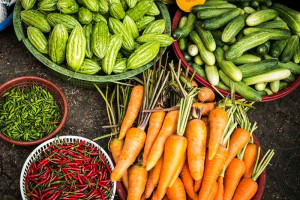
I am not arguing that we should overthrow the modern food system. It provides cheap food, year-round variety, and convenience that past generations could not imagine. The practical approach is to accept the system’s strengths, and then fix its weaknesses by adding a reliable nutritional supplement: fresh vegetables grown in mineral-rich, biologically active soil and eaten quickly after harvest.
Why Wicking Beds Matter
Wicking beds can play a major role because they make it easier for normal, busy people to grow food. They reduce watering effort and reduce water waste—important in dry climates—but the bigger opportunity is nutrition. The real value is that wicking beds can reliably support living soil—soil biology, stable moisture, and minerals—so plants can develop the vitamins, minerals, and phytochemicals that matter for health.
Enthusiastic home gardeners have already done a great job spreading wicking beds. But the potential is far bigger. The mechanics of building beds are now mature; the next step is focusing on soil composition and soil biology, because that is where nutrition is made.
A Reality Check: Home Food Production Can Scale
If it feels far-fetched that home-grown food could become widespread, look at what happened in the UK during the war. A huge proportion of the non-combatant population became involved in food production, assisted by Government schemes. The quantity produced by often unskilled home gardeners was staggering, and the strategy was clear: farmers produced bulk food, while home gardeners produced vitamin-rich supplementary food such as salad crops, onions, and carrots.
You do not need too dry a sense of humour to notice that one of the few occasions Hitler and the British Government “cooperated” was when the blockade forced Britain into mass home gardening—though motives, methods, and aims were very different.
Part 2: Responses to Technical Questions
I received a message outlining major unknowns where proper testing would help: minimum and maximum soil depths, minimum and maximum reservoir depths, whether gravel reservoirs are necessary, and whether salts accumulate in soil or the reservoir—especially when using lower quality water such as greywater or recycled water.
Reservoir and Soil Heights
My recent beds have a variable drain height, either using a rotatable drain or simply folding the liner back. This matters because different plants need different moisture levels at different stages. Some plants (bok choi is a good example) can be prone to fungal attack if the reservoir is too high, while others—watercress for instance—love wet conditions.
My aim is to keep the top of the water level just below the roots. I may fill the bed when seeding and then simply leave it; as roots grow, they draw down the water table. It is lazy, but effective.
Gravel Reservoirs and “Wicking” Confusion
There is widespread misunderstanding about how water moves through soil. Many mechanisms get lumped together under the name “wicking,” even when they have little to do with surface tension (true wicking). In practice, water movement can include hydraulic flow through pores (Darcy-style flow), capillary rise, and other transport effects that depend on soil structure and moisture gradients.
I once did a simple demonstration: I made a hole in the ground and kept it filled with water, then made pencil-sized holes radiating out through a dry lawn. The holes showed distinct zones. Close to the source, they contained visible liquid water with a profile that dropped with distance—classic hydraulic behaviour. Beyond that, there was no visible liquid water, yet moisture effects continued. The point is that several mechanisms operate, and design choices should be based on correct mechanics, not folklore.
So, Are Gravel Reservoirs Useful?
Gravel can work from the narrow point of view of water storage. But if the aim is health—more minerals and phytochemicals—then gravel often contributes little and can even distract people from the real priorities: mineral-rich soil and active biology.
If water storage volume is the only concern (for example, if beds will be left a long time between watering), it is more efficient to use larger pipes or simple containers in the base, because they store water directly. A 90 mm pipe holds almost 7 litres per metre—like a small bucket—so pipe storage can be far more efficient than relying on pore space between stones.
My summary view is straightforward: I am not “against” gravel, but wicking beds should be aimed at improving health by increasing the phytochemicals in our diet. That requires mineral-rich soils and biology. If you focus on those, gravel has little to add, and it is simpler to use adequate pipe storage and fill the bed with the right living soil.
Irrigation Efficiency: What Matters and What Doesn’t
Years ago I developed an adaptive (anticipatory) irrigation approach—essentially a predictor-corrector scheme. You estimate an effective crop factor, predict water need, apply irrigation, then use sensors to detect error and correct the factor for next time. This lets you quantify how much water is used in transpiration versus losses like evaporation and leakage.
You can test efficiency in wicking beds by measuring water added over multiple refills and, if you want to eliminate surface evaporation, covering the surface (turning it into a practical do-it-yourself lysimeter). But in my view, the more valuable comparison is against conventional practice. The big advantage of wicking beds is that they give an automatic scheduling effect, and a lot of water is wasted through poor scheduling in normal gardens.
People have told me they cut water use by up to 50%. That may indicate wicking beds can be efficient—but it also indicates how wasteful conventional irrigation scheduling can be.
Salinity and Salt Accumulation
Salinity control principles in a wicking bed are the same as in saline land generally. Set a minimum and maximum EC. Let EC rise until it reaches the maximum, then flush enough water to bring it back down to the minimum. This is efficient because you only flush water when salt concentration is highest, rather than doing small flushes every irrigation which wastes relatively low-salt water.
In my own normal use I have not had EC problems: my water is good and we have rare but heavy rains that flush beds naturally. I have experimented with grey and black water using a cascading system with non-edible plants first, but I eventually abandoned the trials as a bit of a pain. These days I prefer using waste water to grow organic matter crops for compost inputs, working on the assumption that toxic elements are unlikely to build up in leaves that I then compost. I have no scientific proof—only the fact I have been doing it for years and am still alive.
Final Comments: The Technology Is Mature; the Soil Is the Frontier
In my view, wicking bed mechanics are now quite mature. Many “improvements” I see are simply added complexity built on limited understanding of water movement. Commercial products are often ridiculously expensive. Both trends hinder adoption and work against my original goal: a cheap, easy system that normal busy people can use to grow nutritional food supplements.
The original wicking bed concept was developed while I was working in Africa on sustenance food during drought. It had to be extremely low cost—plastic film in a trench, weeds in the base as nutrient source and reservoir. It worked very well. The big opportunity now is not more gadgets; it is better soil—minerals plus soil biology—so the food we grow is not just fresh, but genuinely nutritious.